Taylor's University Lakeside Campus

Architecture Culture and History 1

Architecture Culture and History 1 is a module that introduces a basic architecture history and theory from the beginning of time to the Enlightenment. Throughout this module, students will be able to classify the sequence of historical periods and how are they presented architecturally.

Project 1A
Students are required to write a 500-word essay to communicate information that is relevant to the precedent study in a group of 4. My group mates for this project were Surayyn, Diyana and Meera. We chose The Elizabeth Tower which is Gothic Architecture. We used appropriate architectural vocabulary referring to building types, styles and period. After completing this project, I learned about the history of how Elizabeth Tower is built and also it's gothic architecture elements.

Project 1B
In project 1B, we are required to produce a A2 size analysis presentation board manually. I managed to produce concept and spatial organization analysis, like symmetry and balance, geometry, patterns and other architectural language in this project. It showed an in-depth analysis of Elizabeth Tower from the information I obtained.

My A2 presentation board


Project 1C
Students are required to create a model to communicate their analysis using balsa wood and a verbal presentation. Although it was very tiring to cut the balsa wood, we really enjoy ourselves the moment doing it together and we were very happy to see our end product. Through this project, I learned about the importance of teamwork. I have recognized and recalled appropriate architectural vocabulary during the verbal presentation.

A mock up we did before starting the actual model

A front view of our model- The Elizabeth Tower

Another view of the model


0 comments:

Building Materials


Building Materials is a module that introduces students various types of building materials. Students will learn different type of building materials in a series of lecture class.

Project 1A
We are required to identify 5 different materials that are being used in the space of our homes. Then, we need to create a catalog of these materials and describe them. The space that i picked for this project is my bedroom. The 5 materials I chose were concrete ceilings, paint, ceramic floor tiles, window iron grilles and glass windows.
My Catalog


Through Project 1A, I learned how to identify different materials used for construction and finishes. Through some readings and searching the internet, I managed to record and produce proper documentation. Also, I recognized the different types of material and their physical and chemical properties.


Project 1B
Project 1B is a group and individual project. In a group of 5, students need to select a commercial/ residential building to experience and explore the building materials of it. My group members were Surayyn, Diyana, Meera and Sonia, we picked a residential building, The Safari Roof House at Petaling Jaya. We went to the house and we analysed the different type of materials used to construct the building. The exterior and interior of the house is basically made out of concrete which makes it very interesting.
Mood Board
Group Presentation Board 1
Group Presentation Board 2

Group photo

My Individual board

Throughout this project, I learned how to identify and analyse different types of building materials. Also, I have further understanding of the physical and chemical properties of building materials. I understood that different materials used will affect the quality and experience of the space. The appropriateness of material used plays an important role in a space or building.


Project 2
This project is related to Architecture Design Studio 1 Project 3 which requires student to produce maximum 2 A2 size presentation boards to document and analyse appropriate building materials to construct for the hideout space they created in Architecture Design Studio 1.

Presenation Board

After completing this project, I have understood more about various types of building materials will affect the tactile and chemical properties of the design or space. I have explored and identified the latest building materials and technology. Then, I also learned the effects of building materials used on structural qualities of space or building.


0 comments:

Design Communication

Design Communication is a module that introduces us design communication skills through proper architecture graphics and also modelling. Students will learn how to express and visualize their ideas and spaces through architecture drawings and modelling.


Project 1
Project 1 is divided into Project 1A and Project 1B. Project 1A required us to use free-hand sketching to record our observation and perception of the two exterior and interior spaces. On the other hand, students are required to produce 4 variations of tonal value sketch of an image they chose in Project 1B. After gone through the first project, which are Project 1A and 1B, I understood the notion of space in architecture form and I learned how to appreciate the space. I was able to use to four basic techniques of rendering, which are hatching, cross hatching, scribbling and stippling to develop my skills in sketching as a mode of communication. Besides, i have learnt how to visualize a space through observation and perception. I have enhanced my skills in creating depth and tone to produce an architecture sketch.
Project 1A- Kitchen
Project 1A- Living Room
Project 1A- Queen Victoria Clock Tower

Project 1A- Penang Heritage

Project 1B- Hatching

Project 1B- Cross Hatching

Project 1B- Scribbling

Project 1C-Stippling

Project 2
There are 3 parts for Project 2, which are Project 2A, 2B and 2C. In Project 2A, we are given a building named Barcelona Pavilion and we are required to produce orthographic drawings: plans, elevations and sections of it. At first, it was quite hard for me to find the information and measurements of the building but after gone through some searching through the internet and also some readings, I managed to find the information and measurements of the building with the help of my friends. In the process of inking this project, I learned that there are different type of lines, different line weights and also the quality of lines. Through Project 2A, I learned the appropriate way to record and to produce architectural information clearly in a manual way. Next, I have learnt to identify and apply architectural symbols and conventions. At the same time, I managed to use back my rendering techniques that I have learnt from Project 1 into this project to show my understanding of lights and tones.

Project 2A: Orthographic drawings


In Project 2B, we are required to produce a sectional axonometric projection of Barcelona Pavilion. First, I referred to my previous project, Project 2A to get the information and measurements I had throughout this project so that I can produce my axonometric drawing. After gone through this project, I understood what is axonometric projection and I learned the appropriate techniques to produce it. Besides that, I learned how to communicate my understanding of architectural details and spatial values in three-dimensional with clarity and accuracy. In this Project 2B, I have also improved my line weights and neatness of lines compared to my Project 2A. Besides, I have known the importance of the layout of a professional presentation board.

Project 2B: Axonometric Projection


Basically, Project 2C required us to produce two perspectives drawing (one-point and two-point perspectives) of Barcelona Pavilion (exterior and interior). For me, I used my orthographic drawings (2D) to translate into this perspectives drawings (3D). It was quite troublesome at first as sometimes i will get confused with the lines but at the end it turned out to be quite easy once we get used to it. I learned about what is picture plane (PP), viewing angle, stationary point (SP) and more. It was very interesting to express spatial ideas and architectural details in the format of one-point and two-point perspectives. Then, I have learnt that planning is very important as I need to consider what views and details I want to capture and show. To enhance my perspectives drawings, I have applied different types of renderings on my perspectives drawings to make it more lively.

Project 2C: Perspectives


0 comments:

Architecture Design Studio 1

Architecture Design Studio 1 is a module that introduces architectural design. The aim of this module is for students to express individual self expression and body to present and explore design. Throughout this module, students will be able to generate design concepts through the process of exploring different kind of sources and abstracting ideas


Project 1

The phase which is the grid design
In Project 1, we are required to identify and themes or ideas of  "self" and do a interpretative piece of it.  I did a sculpture that represents me. The sculpture has 3 phases. The first phase is in a grid design. It symbolizes I am an organized person. The second phase shows the part of me where I have bad-tempered. The red triangle symbolizes fire and anger. The third phase shows that I am imaginative and creative. I stuck it randomly which symbolizes imagination can be anything in different ways.


The phase that shows I have bad-tempered
The third phase that shows that I am creative
Throughout this project, I have identified and abstracted "myself". Now, I know more about my characteristics and personalities. Also,through the process of translation and interpretation based on what I have abstracted and redefined, I learned how to construct a representational piece of art that best represents me. Although I encountered some problems of translating my personalities into an artwork at first, I used different kind of approaches to design thinking and production.


Project 2
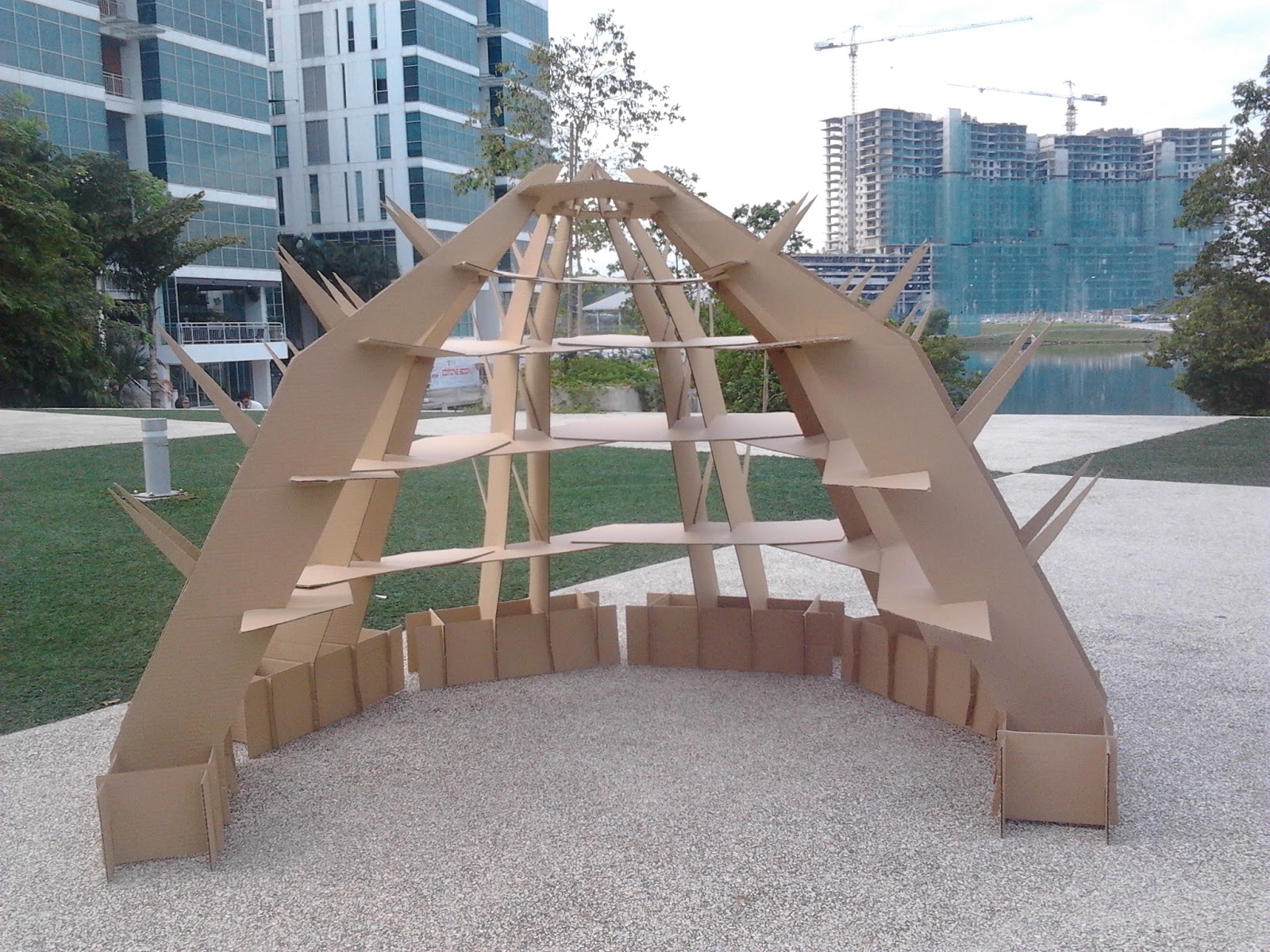
After gone through the whole identifying "self" in Project 1, we were grouped in a number a three in Project 2. My group mates for this project were Er Hao and Jean. In this project, we were required to expand the interpretation of self and how this is to be expressed spatially by creating a 1:1 installation. My group mates and I brainstormed together and we ended up picking each of our personalities and transform it into a space. Then, we started to explore the notion of scale and proportion. In the end, we came out with a semi-covered octagonal spherical shell.


The front view of O3
O3 is the name of the installation created as it is defined by 3 quarters of an octagonal plan. 3 main emotions can be perceived within the structures interior space. The sheltered space offers a sense of security and reservation while the spikes that can we observed from the inside evokes a sense of boldness. The space is suitable for musing which is a universal act. Lastly, O3 ceilings feature an occulus, allowing one to look upon the vertex that is formed out of triangles which symbolises the unity of 3 persons in creating O3.


The side view of O3

Me sitting inside O3 which is a metre tall
A3 size presentation panel for this 1:1 installation

After completing this project, I feel that I have further developed my ability to create a conceptual narrative. I have applied the basic design principles, like geometry, repetition and hierarchy into space and form. I was aware of the importance of human scale and proportion while creating the installation. Besides that, the exploration of human anthropometry and relating it into space was very interesting although was not easy. Thus, I understood how does body inform space and how does space     inform the body throughout this project.


An exercise we did before Project 3: Designing a space

Mock up model


Project 3
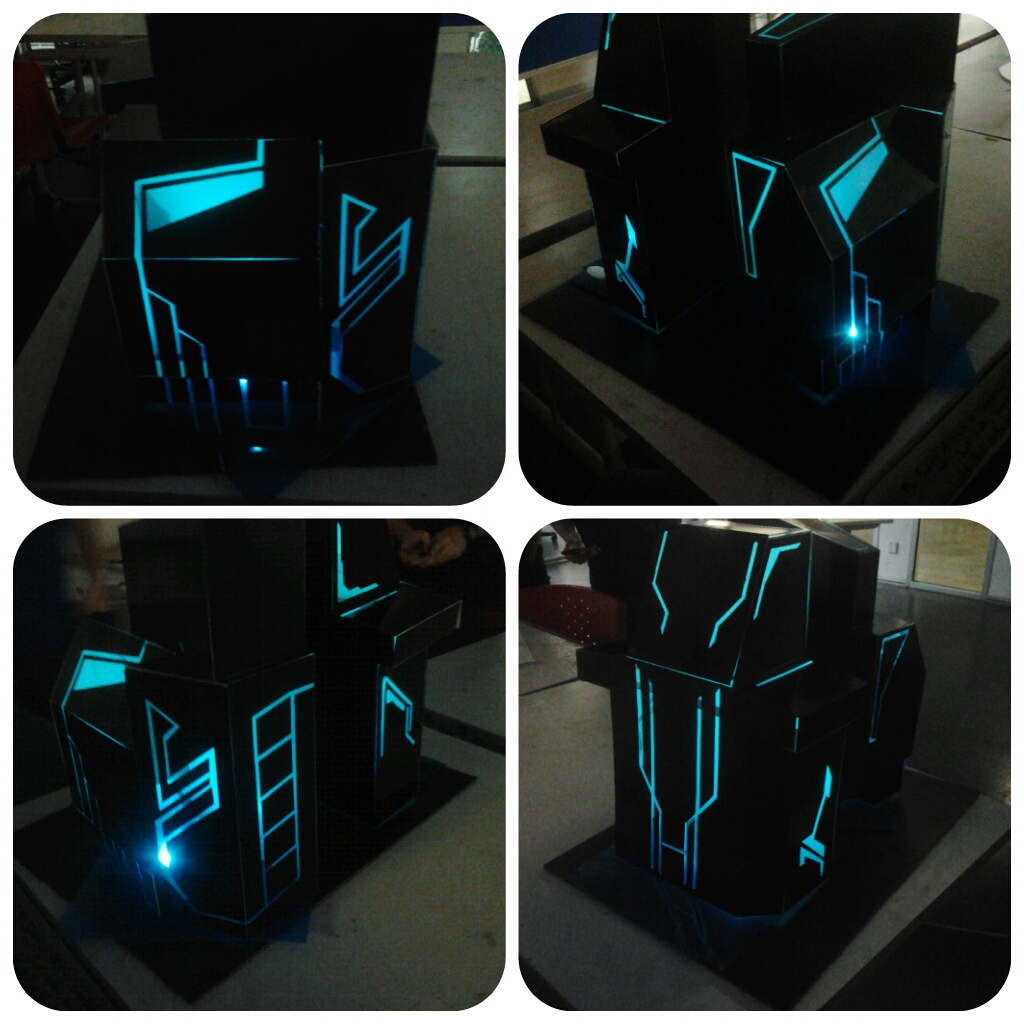
In Project 3, we are required to design a hideout space by engaging it to the walls of an imagined city on an empty abandoned plot. There are 3 tasks for this project. For task 1, we need to understand the site on the selected films and look for inspiration for the character and hideout that we are gonna create. In task 1, I was teamed with another 5 members, who were Xuan Ning, Er Hao, Victor and Jean. The movie that we picked was Tron: Legacy. We built the site model of it where there were 2 buildings and an alley between it .

Our site model--Tron: Legacy


In the second task, we were required to create a character and a narrative for the movie. The character I created was basically the main character's younger brother who I named him Daniel Flynn. Daniel hates his father a lot since he was little as his father abandoned them and went to the grid. He got jealous of his brother, Sam as Sam is the primary shareholder of the company and he got nothing. One day, he found out about the "The Grid" that his dad created and he started to plan his revenge by helping CLU (a hologram that  his dad created) to impose the system to the real world. So, Daniel's characteristics are lack of love, get jealous easily, stingy, secretive and lonely. 

In the third task, we need to design a hideout space for the character we created in the alley of our site model based on key themes of conceptual development, scale and proportion (anthropometry) and basic design principles in spatial organizations and relationship. We also need to choose and apply the appropriate materials that can best relate and inform the sensory experience of space. The hideout that i created is basically a cube which is pixelated to symbolize Daniel helping CLU to impose the system to the real world. The exterior of the hideout looks strong and solid but the interior is empty to show that Daniel looks strong from the outside but inner part of him is very lonely and quiet. There are 2 floors in this hideout. The first floor shows Daniel's personalities as a lonely person and the ground floor is for him to plan his revenge. The staircase from the first floor to the ground floor is to represent how depress his life is. 
3D Model

Presentation Board 1

Presentation Board 2
Exterior view of my model

Interior of my model

Mock up to Final Model
My model in the site model

Me and my presentation boards

After completing this project within 7 weeks, I learned how to design a space that can best represent an idea or conceptual narrative. I have also used the design principles and elements, like transformation of form, repetition, rhythm, hierarchy and more in my design. Also, I learned to explore and apply different variation of materials to enhance the sensory experience of my space. And most importantly, I learned how to distinguish the role of scale and proportion in the relationship between designed space and human body.

Below is the Sketch Journal I did for this entire semester. Hope you enjoy it.


0 comments:

Contact Me

E-mail address: eugene_ys94@hotmail.com/ youshing.soh@sd.taylors.edu.my


Twitter: Follow me @sohyoushing

Instagram: Follow me @sohyoushing

0 comments:

About Me


Name: Soh You Shing

D.O.B.: 27th June 1994

Hometown: Penang, Malaysia

University: Taylor's University Lakeside Campus

Course: Bachelor of Science (Honours)(Architecture)

Interest: Architecture/Chinese Calligraphy/Drawing/Music


0 comments: